One Thousand Apologies

Dear Reader

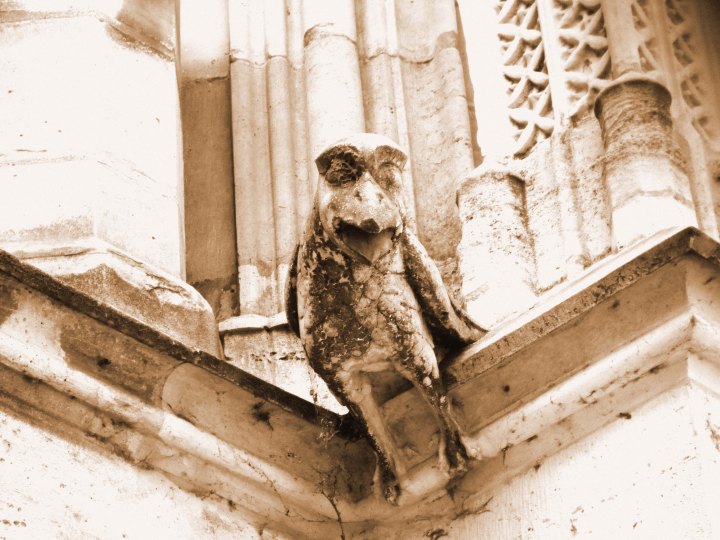
We can only apologise from the bottom of what passes for our hearts for our failure to post something last Friday. All we can give in the paltry way of excuses is that we are in the middle of an international house move. We offer this picture of a gargoyle from the Notre Dame in Paris, which will be featuring in a story in the near future, as recompense.

gargoyle_edited-1


We are also excited to announce that a new Jennings and Jennings story will be starting next Tuesday. You will gasp in horror, recoil in terror and be otherwise discombobulated by… the Fulham Fiend.

The Mancunian Mesmerist: Epilogue

The four seater train compartment was filled with boxes and a man and a woman. The man was frowning and obsessively hanging on to the boxes as the train made its bone-shaking journey. At each jolt and rattle he seemed to be trying to hang on to all the boxes at once. The woman gazed out the window at the rainy landscape with a half smile on her face.

“Well, it’s good to be going home,” said Sir John, “even if it is in this terrible train again.”

“Yes,” said Marie. “I’m looking forward to getting back. Did you find out about Clackprattle and Pook? Did the constabulary find them.”

“No,” said Sir John. “By the time I had explained and then convinced everyone what had happened Pook and Clackprattle had long gone. They had been renting some rather fine rooms in the Britannia Hotel. They were empty when we got there.”

“I hope they’re caught,” said Marie.

“Well, Clackprattle’s a devious swine for certain, but I don’t think we need to worry about an oily little character like Pook,” said Sir John. “I imagine he’s perfectly harmless without his master in tow.”

They fell silent for a bit, then Sir John said, “How did it go with the Copperwaites?”

“Oh,” said Marie, “I nearly forgot. When I got back of course she had awakened and there was a lot of activity in the house. I tried to speak to the father, but he ignored me saying our services were no longer required as his daughter was better.”

“Oh dear,” said Sir John. “So they didn’t realise we were responsible for that?”

“Well, I spoke to the maid, you know the one we…” started Marie.

“Yes, I know,” said Sir John.

“Well, she let me speak to the daughter, Lillian for a few minutes. I explained what had happened, how she had been mesmerised by Pook … and, er, Clackprattle. I explained what they had been trying to do. She seemed to understand.”

“That’s good, I suppose,” said Sir John, looking a little glum. “Still, I was rather hoping to get paid this time.”

“Well, as I was packing up our room the maid came and gave me this envelope. That is what I forgot.”

Marie took a letter out from her handbag and passed it to Sir John.

“Dear Sir John and Mrs Jennings,” he read, “Thank you so much for rescuing me from the clutches of that evil monster, Clackprattle and his vile servant, Pook. I am grateful beyond measure and want to demonstrate that gratitude to you. I feel that what you have done for me is so great, that no amount of money could ever match it. So instead I have chosen to give you something priceless. I enclose a precious piece of art that I have made to recognise what you have done.”

“Oh dear,” said Marie.

“Well, perhaps this art will be valuable?” said Sir John.

In with the letter was another piece of paper. The Jennings both looked at it.

“Hmm,” said Sir John. “Probably not.”

MM Epilogue“Probably Not”

Faerie-Folk of England

Chapter 23 The Pookah

(Extract from “Faerie-Folk of England” by Rev Wilson Lillywhite, 1917)

If ever you find some small but important object has gone missing from where you were sure you left it, or if a mechanical device that worked only the other day has ceased to work, you may be playing host to a Pookah. This type of faerie delight in causing confusion and chaos in the house and are sure to move things, hide things or otherwise make merry mayhem. They are quite reclusive, preferring to work in secret, not at all like those Northern faeries that seem to crave the photographic camera. They are naturally shape-shifters so may appear as almost anything to suit their environment. A horse, a goat, a rabbit, or even a person.

The name itself may come from the Norse pook which refers to a nature spirit. In Irish mythology it is a Puca and a Pwca in Welsh. There are as many different spellings as there are forms this playful creature may take. One name of course is Puck, as William Shakespeare called him.

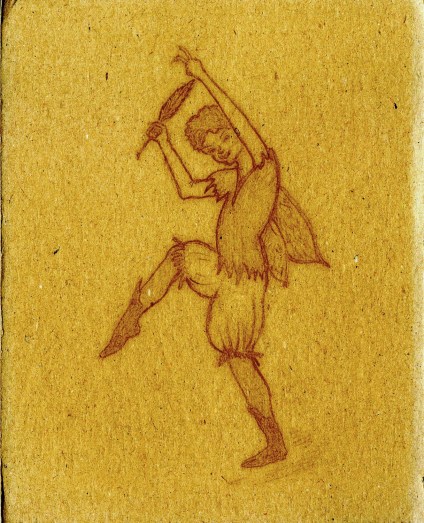
pookah sepia

Pookah’s are famous for being both helpful and unhelpful. They may find things or steal things and may lead travelers astray into the woods. My personal theory is that even when they are being helpful they are probably planning some misdemeanour or other. A story of mine illustrates this point.

Several years ago I was visiting a house where a pookah had taken residence. This mischievous little creature was driving the family to distraction with its petty meddlings. When I arrived, I was given an overwhelming list of stories by them that I was eager to write down. I looked in vain for my pen, which I could not find. I exclaimed aloud how much I wished I had my pen and then felt a sharp tap on the top of my head. I took off the hat, and there was the pen. The family and I all had a little chuckle at the impudent creature. Whenever a Pookah is about, this sort of roguish prank is sure to happen!

The Mancunian Mesmerist: Chapter 14

The room was full of machinery and there was a low electrical hum. In the centre of the room was a table with a map on it and standing over it Earnest Pook. He was humming cheerily to himself. Marie walked into the room.

“I was wondering,” said Pook, not looking up, “whether I should have Victoria give me India or Africa. What do you think?”

“I think it’s not a very good disguise to use what you are as a name, pookah,” said Marie.

“And I don’t think it’s a very good idea to walk into a pookah’s house with a stone bug in your hand,” said Pook, still looking at the map. “Although in truth I knew you were special even back in the church.”

“Does Clackprattle even know what you are?” asked Marie, walking closer to the table. Pook chuckled.

“Oh, poor, deluded Arthur, ‘master mesmerist’,” he said, mimicking Clackprattle. “Naturally, he has no idea. There’s no such ability of course, it’s all just magic. My magic. With a little glamour to hide it from prying eyes.”

“And the girl?” said Marie, edging quietly closer.

“She was so useful for a while, so wonderfully gullible,” said Pook, not moving. “I didn’t even need to enchant her. She bought us some wonderful toys. Then she got into her head that the Telharmonium was a bad idea. So, nighty, night … she went to sleep.”

“But then her father stopped the money,” said Marie. “So you made her wake at night to write letters and cheques, to keep the institute going.”

“Yes, clever aren’t I,” said Pook. “I imagine next you’ll ask me which lever to pull to turn this all off. And I’ll tell you of course just to show you how clever I am.”

“Does the Sphere of Lethe even do anything?” asked Marie, close to the table now.

“Oh, now you’re being the clever one!” said Pook. “Mesmer wasn’t an idiot. He knew well enough, like me, to have something gaudy, large and dazzling for the paying customers to focus on. No, I’m afraid the real power lies elsewhere.”

Pook suddenly turned from the table, just as Marie was right behind him.

“But you’d know all about that, wouldn’t you?” he sneered. “About using something else to disguise your powers.”

“So… so you have something magical,” said Marie, flinching. “Pookah’s aren’t as powerful as you normally.”

“No, indeed,” said Pook. “Time was that when a humble old pookah tussled with a witch, that the pookah would lose hands down. But as we saw, when you tried to make that boy talk, it seems we’re evenly matched.”

Marie looked down.

“In fact, one could say we were very similar indeed,” said Pook. “Same powers, same method of disguise. Are you sure you want to stop me? Perhaps you’d rather join me? Just think, Clackprattle and Jennings, what a great puppet show. We could tour the the world.”

“I’m not like you, and he’s not like Clackprattle,” said Marie, still looking down.

“How can you stand it?” said Pook, coming close to her, and resting a hand on her cheek. “How can you stand to be in the shadow of that pompous moron?”

Suddenly Marie grabbed for the jewelled pin on Pook’s cravat and shouted, “ALLER!” Pook flew across the room and crashed into the wall. His face looked shocked as he started to rise. “RESTER!” shouted Marie and he sat still.

Marie stared at the creature, one hand on her hip and breathing hard.

“I know, little creature, that you are made of trickery and chaos. So I forgive you. But don’t you dare compare yourself to me. I do not play games with people’s lives,” she said.

She dropped the cravat pin on the floor.

“And I know exactly how to ‘turn this all off’,” she said and stamped on the pin, smashing it. Pook cried out in horror. Marie said “dormir” and he slumped unconscious. She stood there for a moment, staring at the sleeping creature before turning to walk out the door.

“I am a witch,” she said. “We are always in the shadow.”

As she walked out the door, she clicked her fingers and the door slammed shut behind her.

marie door 3

The Mancunian Mesmerist: Chapter 15

Your Call is Important to Us

Extract from “Your Call is Important to Us: Towards a Socio-political Praxis of On-Hold Music by Dr Jeff Grunt.

It has been well documented in this treatise how poor cultural framing of “on-hold music” can induce cognitive dissonance in the intended audience. British users of Southern Rail’s helpline demonstrated this cross-wiring of outcome and intention quite clearly when 56% reported they were “quite distressed” or “very distressed” when hearing The Four Seasons by Vivaldi, apparently as it reminded them that British weather was more homogenous, located as it is in a generic “single season” paradigm of rain and wind.

What has been less well researched has been the kinetic-auditory impact of, for example, timbre and “note envelope” parameters. Anecdotally, a lower-quality under-developed timbre may induce a certain displeasure, but there has yet to be a wide-scale analysis of, for example, whether Beethoven’s Ninth is less likely to provoke negative-biased responses when played by a full orchestra rather than on a stylophone.

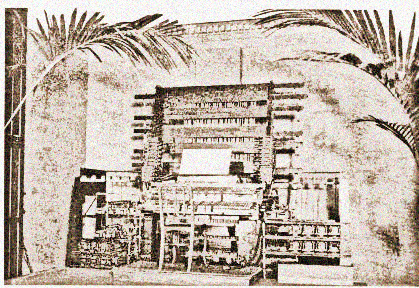
Teleharmonium1897_edited-1

Nevertheless, an early attempt at producing telephonic music may prove instructive, especially as to its demise. The “Telharmonium” (pictured above) was an early electronic instrument developed in the later Victorian era by a Thaddeus Cahil. Three versions were produced, the last weighing around 200 tons. The instrument itself would take up an entire room.  Thus, proving unwieldy to travel, the instrument was used primarily for telephone users to listen to music. However, despite the relative unavailability of recorded music at that time, the telharmonium was not a success. Notwithstanding the tremendous power consumption required, the fatal flaw seemed two-fold.

The first problem noted was that the basic sound, a sine wave, was “pure and clear”. Although there were options to modify this source, I contend that this purity, this perfection, may well have contrived to create displeasure. The sounds may have been unearthly or ethereal to the listener used to the more visceral sounds of a street urchin playing a violin. Secondly, there are also reports of cross-talk incidents, where conversations were interrupted by ghostly music. In all, by the early part of the 20th century, the instrument had lost favour and fell into disuse.

We can, I think, conclude clearly that here we have less a sociological issue than a timbral one. I shall be exploring this more thoroughly in the next chapter “Windpipes and their Role in Helpdesk Worker Abuse.”

(Dr Grunt is Lecture of Muzack at UMIST and is also author of “Elevation: The Use of Religious Music in Lifts” and “Liminal Exotica: Bossa Nova Rhythms and Hotel Lobbies”)


The Mancunian Mesmerist: Chapter 13

The well dressed people gathered at the large lobby of the Peitho Institute, Marie and Sir John amongst them. Fine wine was being passed out by waiters and there was a pleasant hubbub of genteel conversation. A makeshift stage was built at the back of the room, and occasionally Earnest Pook would peer over it and smile.

“May I take your hat and coat, sir?” said an usher to Sir John.

“Er, no, I’m fine, we’re fine,” said Sir John. “We’re from London.”

“It’s starting,” said Marie as Earnest Pook walked onto the stage. He was dressed in an expensive looking suit with a silk cravat and jewelled pin.

“Good evening, ladies and gentlemen,” said Pook. “You are most terribly, terribly welcome to this event, the inauguration of our most audacious project yet. And to this end, in an act of generosity that behoves one as magnificent as himself, our benefactor has agreed to come and speak. He is, as many of you know, not one for the spotlight, not one to thrust himself into public discourse. Not that he lacks the requisite skill or talent for communication, oh no, but merely because he prefers his works to speak for themselves without the unnecessary personal adulation that such can so often accompany philanthropy such as his. I present, Arthur Clackprattle.”

MM Ch 13“The Sphere!”

The hubbub increased as people craned to look at who was coming onto the stage. An obese man dressed in a gaudy costume and with an arrogant look on his face walked onto the stage. Around his neck was a large necklace, with a transparent sphere in a metal coil.

“Look!” said Sir John, “The sphere!”

“Good evening to everyone,” said Clackprattle, “and welcome to this event. It is so wonderful to see so many of Manchester’s finest here. I am so pleased to be able to show you tonight just how incredible a machine we will be unveiling. Many of you may be wondering what it does. Well, rest assured, I shall tell you.”

There was general chatter as the crowd tried to gauge Clackprattle and some suppressed laughter at his unusual dress.

“Silence!” roared Clackprattle. The crowd fell instantly silent.

“That is so much better,” continued Clackprattle. “Silence is truly golden, especially when it’s silence from such a fatuous, smug, and profoundly self-indulgent collection as yourselves.”

No one spoke or moved.

“So, you should all be very pleased, as tonight we shall put Manchester on the map. In the very center of the map in fact,” said Clackprattle, getting more manic with each sentence he spoke. “You may have heard that this contraption will be sending music to owners of telephonic devices. Nothing could be further from the truth. You see, this Telharmonium will be sending my power instead. Anyone who picks up that receiver when we call shall be under my control, and I shall rule England and the Empire!”

Still, no one spoke or moved.

“I imagine,” said Clackprattle,” that you find all of this a little alarming. I imagine you’d like to stop me. But as I’m sure you’ve discovered, you can’t move, and you can’t talk, thanks to this little beauty.”

Clackprattle stroked the metal coil that housed the sphere and said,  “And thanks to another beauty. What you might call a ‘sleeping partner’.”

Clackprattle turned to go, chuckling a little.

“Come on Pook, you start the generator and I shall man the microphone,” he said, before looking back at the static audience. “You lot can get ready to bow to me later.”

The tall fat man and the small thin man left the room, the former going right and the latter going left.

Sir John and Marie both let out a breath.

“Good job these hats worked,” said Sir John, looking around at the motionless crowd. “Right, you wait here and I’ll tackle Clackprattle.”

“Be careful, mon cher,” said Marie.

Sir John nodded and then headed off down the right-hand corridor. Marie waited until he was gone then headed down the left.

The Mancunian Mesmerist: Chapter 14

The Mancunian Mesmerist: Chapter 12

It was the eve of the visit to the Peitho Institute, and Marie and Sir John sat in their quarters in the Copperwaite mansion. Both were silent, thinking of their invitation for the following day and the deadline the day after. Mrs Harper arrived with some supper which she set on a table.

“Thank you,” said Sir John absently.

“Will that be all?” said Mrs Harper. “No need for anything else? Any information? Only I’m free for lunch tomorrow…”

“No that’s fine,” said Sir John. “Oh wait, there is one thing.”

“Twelve o’clock would suit,” said Mrs Harper.

“It’s just a quick thing,” said Sir John. “You said that Miss Copperwaite had an idea to play music through telephonic devices? But you changed her mind?”

“Yes, sir,” said Mrs Harper, “I told her it was a bl… that it wasn’t a very good idea, and she agreed and said she wouldn’t do it. That was just before she fell ill, in fact.”

“I see,” said Sir John. “That will be everything, thank you.”

Mrs Harper looked a little crestfallen and left the room.

MM Ch 12“Tin Hats?”

“Do you know what I think?” said Sir John.

“That Clackprattle made Miss Copperwaite buy the sphere? That he wanted to build this musical telephone machine as well? And that he made her go to sleep when she said no to that?”

“Yes,” said Sir John, looking crestfallen now, “but why?”

“Did you say that this sphere increases his powers through sound? Perhaps he doesn’t want to send music through the devices … perhaps he wants to send mesmerism.”

Sir John gasped.

“Good lord!” he exclaimed. “The Queen has one, you know! We have to stop him!”

“Well, we have an invitation to see it happen…” said Marie, “…which is very strange. I feel it must be a trap of some kind.”

“I think so too,” said Sir John. “Well, I have some ideas to save us from that. Firstly, I’m going to put tin inside our hats.  Then, I’m going to adapt my ionospheric emitter to shoot powerful electric charges. And most vitally of all, I’m going to borrow your earmuffs.”

Marie look perplexed.

“Tin hats? Ear muffs?” she said.

“…So I can’t be mesmerised when I tackle Clackprattle,” said Sir John, pointing to his ears. He left the room whistling to himself.

Marie looked at their hats. She put a finger gently on each one and said “proteger”.

The Mancunian Mesmerist: Chapter 13

The Mancunian Mesmerist: Chapter 11

The yard was filled with men carrying large and complicated bits of machinery and tubing from a horse and cart toward a large building.

“Another one?” said a man coming out of the building. “We’re supposed to be an art gallery not a factory.”

“Boss’ orders,” said a second man, as if that explained it, then looked to see a woman turning into the yard. “Can I help you miss?” he said.

The woman was holding something in her hand and glancing down at it from time to time. She walked over to the man who had addressed her.

“Yes,” said Marie. “Can you tell me where we are?”

The man heard her accent and strange question and began to speak slowly. “This is the Peitho Institute, miss, on Albion Street.”

Marie nodded as if expecting that and closed her hand. She then asked, “What are you doing here?”

“Ah, can’t tell you that miss… boss’ orders,” he said and smiled sheepishly.

Marie began to say something in French, then stopped herself. A shadow of sadness passed across her face. The man saw this and concern spread on his.

“Well, maybe I could explain…” he started.

MM Ch 10 sepia“Little Familiar”

“Marie?” called Sir John, coming round the corner. “What are you doing here?”

“I … I went for a walk mon cher and found myself here,” she said. “This man was just telling me about the Institute.”

“Oh good!” said Sir John, turning. “How are you carrying on without Miss Copperwaite’s patronage?”

The man looked confused when a slight, short man came out into the yard. He walked over and looked at all of them, his head turning in a birdlike manner.

“Now then Wilson,” said the man, “no need to stop working. I can talk to our guests.”

He indicated the machinery being unpacked and the workman went over to it.

“I’m so sorry,” said the birdlike man, “but we haven’t made all of the staff aware of the, er, condition of Miss Copperwaite. We fear it would be bad for morale. But please, allow me to introduce myself: My name is Ernest Pook.”

“Good day, Mr Pook,” said Sir John, “I am Sir John Jennings and this is my wife, Marie.”

Pook nodded and turned to Marie.

“Is it possible we may have met?” asked Pook glancing briefly at her hand. “You seem … a little familiar.”

“Not that I know of, sir,” said Marie. Her fingers twitched as if something was trying to wriggle out of her hand.

“I take it you’re in charge here?” asked Sir John.

“Good Lord, no!” exclaimed Mr Pook. “I am a mere presser of buttons, turner of wheels, puller of strings. No, I am under the instructions of our institute’s benefactor. He is a gentleman of wealth and taste, who has stepped in to assist due to the unfortunate circumstances of Miss Copperwaite.”

“Who is this benefactor?” asked Sir John.

“Alas sir, I cannot say, for his modesty is as great as his generosity,” continued Pook. “He wishes to remain incognito. But sir, an idea has struck me. If you are so very keen to meet him, perhaps you will come tomorrow? We have a very special soiree to celebrate our latest artistic endeavour. Mr Cl… I mean our gracious benefactor will be on hand to say a few brief words.”

“Well, that sounds most satisfactory,” said Sir John. “May I ask what the endeavour is?”

“Of course,” said Mr Pook. “It is a most exciting and enticing enterprise. We are having our first unveiling of our Telharmonium: our device which will send music through the telephonic devices to enrich the lives of all those who hear it.”

The Mancunian Mesmerist: Chapter 12

The Mancunian Mesmerist: Chapter 10

MM CH 10“Three Days!”

“Arthur Clackprattle!” bellowed Mr Copperwaite. “You’re here for weeks at my expense and when I ask you what you’ve found out, that’s all you can give me?”

“Well, there is a little more” said Sir John, sitting, along with Marie, across from the desk. “I take it you’re not familiar with the gentleman?”

“No!” said Mr Copperwaite. “I am not familiar with the gentleman. I am, however, familiar with your antics. I know, for example, that part of your so called investigations involved a trip to the theater. I know that you, Sir John, treated my beloved daughter as a plaything. And I know that you bought a member of my staff a dinner of lobster and champagne.”

Mr Copperwaite was looking quite as red as that lobster, Marie thought.

“Yes, that was a misunderstanding,” started Sir John.

“I don’t mind what you waste your money on Sir John. That’s your business, even if it does mean my Christmas bonus to the staff will raise eyebrows rather than spirits.  No, Sir John, what really bothers me is that a man who’s supposed to be an expert investigator of the occult can’t even see what’s in front of his bloody nose. That must be the oldest trick in the book, and you fell for it. How then, Sir John, am I to judge your performance when I ask what you’ve learned and you give me a name that sounds like it belongs to a bloody clown.”

Mr Copperwaite slumped back. Sir John waited but it seemed the rant was over.

“Well, that name belongs, so I’m told, to a master mesmerist,” said Sir John.

Mr Copperwaite gasped.

“What new nonsense is this? Now I’ve heard it all!” he said, starting up again. “What does this master of mesmerism do? Let me guess, he’s keeping my daughter asleep.”

“That’s what we suspect,” said Sir John.

“And why is he doing this, may I ask?” said Mr Copperwaite.

“We don’t know,” admitted Sir John.

“And where can he be found, so we can ask him?” said Mr Copperwaite.

“We don’t know that, either,” said Sir John.

“And how is he carrying out this marvellous trick?” said Mr Copperwaite.

“Ah, there I do have some information. We believe he is firing electricity at her from his pineal gland,” said Sir John, more confidently.

“He’s doing what!” roared Mr Copperwaite and thumped the desk.

“That’s just a theory at this point,” said Sir John, hoping to placate the man.

“Sir John, let me be clear, when we started I had no faith in you, and I now have less than that. You have three days to tell me something useful and plausible about my daughter’s condition or you’ll be back on that train to London, where you can con the gullible fools who live there as much as you like. Now you’ll have to excuse me, I have some real work to attend to.”

Mr Copperwaite started to rise.

“Mr Copperwaite?” said Marie. “May I ask a question?”

Copperwaite glared down at her. “What?”

“Your daughter runs an institute of some kind, for art, could you tell us what the name is?” asked Marie.

“Was,” said Mr Copperwaite. “That was the first thing I put a stop to, pulled the funding out of it. I can’t remember the name, something like python institute. Forget it, it’s gone. As you will be if I don’t see results. Three days, Sir John, three days.”

With that, Mr Copperwaite left. Sir John let out a breath.

“Well, that could have gone worse,” he said. “Possibly. We have three days, at least.”

“We should investigate the institute,” said Marie. “They are the ones who bought this sphere you mentioned.”

“If it still exists,” said Sir John glumly. “I’ll try to find it tomorrow. But I’ll go alone. If this Clackprattle chap is as dangerous as we think, I don’t want you near him. Will you be alright on your own tomorrow?”

Marie felt a tapping against her shoe. She looked down and saw a small stone.

“I think I can keep myself entertained,” she said.

The Mancunian Mesmerist: Chapter 11

The Mancunian Mesmerist: Chapter 9

The study was covered in books and had two comfortable chairs in front of a roaring fire. A man was sitting in one of them with a book on his lap and was snoring gently. There was a knock on the door and he sprang up. He opened the door and peered out to see Sir John Jennings in the street.

“Professor Herringbone-Stove?” asked Sir John.

“Who is enquiring?” said the man.

“It’s Sir John Jennings,” said Sir John. “I believe I have an appointment?”

“Ah, yes!” exclaimed Herringbone-Stove. “Come in!”

“Professor Herringbone-Stove?”

Sir John walked into the room and the professor glanced up and down the street before closing the door. He indicated the unoccupied chair to Sir John, who sat down.

“Just out of interest,” said Sir John, “which university are you attached to at the moment.”

“Well I’m at…” started Herringbone-Stove, before commencing a long coughing fit, during which he sat down opposite Sir John. The professor leaned forward and arched his fingers and his eyebrows.

“So,” Herringbone-Stove said, “ you wish to know about … mesmerism!”

“Indeed,” said Sir John enthusiastically. Herringbone-Stove looked a little disappointed at this response. “I have a case at the very moment that I feel you may help me with. You see it concerns a woman who I believe is under the thrall of a mesmerist. I believe him to be working to a most diabolical purpose.”

“Strong words sir and easily misused,” said Herringbone-Stove. “Some of my lectures have been described as diabolical.”

“I’m sure they have,” said Sir John. “But the fact remains, she is catatonic, the doctors can do nothing, and her last known contact … was a mesmerist.”

“Fascinating,” said Herringbone-Stove, “but I still doubt your theory. To be able to carry out such an feat, a man would need tremendous mesmeric powers, even with the help of something like the Sphere of Lethe.”

“The Sphere of Lethe?” said Sir John.

“It was an artefact possessed by Mesmer himself, that purportedly amplifies mesmeric power,” said Herringbone-Stove.

“Good Lord! Named for the river, I suppose,” said Sir John.

“The river?” said Herringbone-Stove.

“The River Lethe. One of the rivers of the Greek underworld.”

“Let me just write something down unconnected to our conversation,” said Herringbone-Stove. He started to write on a pad and said “riv – er” under his breath.

“So how does the Sphere work?” asked Sir John.

“Ah! Well, I have a theory,” started Herringbone-Stove, “that it works by enhancing aural electricity. You see, I firmly believe that mesmerists have long misunderstood their own power. They call their powers animal magnetism, and Mesmer himself believed it was identical to actual magnetism. This is palpable nonsense. The power that mesmerists use is clearly based in electricity, produced by the pineal gland, directed at the target and amplified by auditory excitation. The sphere, I believe, further increases this auditory excitation, thus enhancing the mesmerist’s power.”

“Fascinating,” said Sir John. “But how would this auditory excitation work? And how might one defend against it?”

“You, sir, are as ugly as a baboon!” shouted Herringbone-Stove.

“I beg your pardon!” said Sir John turning red.

“You see, that is an example of auditory enhancement of mesmeric electricity. I fired my pineal gland at you and enhanced that with the power of my voice. It provoked in you a marked emotional response, namely rage. That is the power of the mesmerist.”

“I see,” said Sir John, still shaking a little.

“I posit that there are two forms of defense against this. The first is that one must block up the ears to ensure they do not hear the voice of the mesmerist. The second is to direct a beam of electricity back at the mesmerist’s pineal gland. Sadly, I am no engineer, but I have no doubt that in this modern age a suitable device could be made.”

“So where is this sphere?” asked Sir John.

“Well, until recently it was held in the British Museum in London in a display of Mesmer’s effects. But I believe last year the whole collection was sold to a local artistic foundation. Around March, I think. They were displayed here in Manchester briefly. But really, Sir John, it would take a master mesmerist to use this device.”

“Professor Herringbone-Stove, my client is connected with an artistic foundation and last April was when she was struck down. I now wonder whether this Sphere was used to do that.”

“Good Lord!” said Herringbone-Stove, leaning forward and lowering his voice. “But there is only one man I can think of so powerful and malignant. Only one who would dare to defy the laws of nature in such a way. Only one who might sink to such depravity!”

“Who, man? Tell me!” said Sir John, leaning forward too.

Professor Herringbone-Stove moved as close to Sir John as he could. His face was pale and his voice barely a whisper.

“His name sir … is Arthur Clackprattle.”

The Mancunian Mesmerist: Chapter 10