The Paris Awakening: Initiation Part 1

absinthe_pp

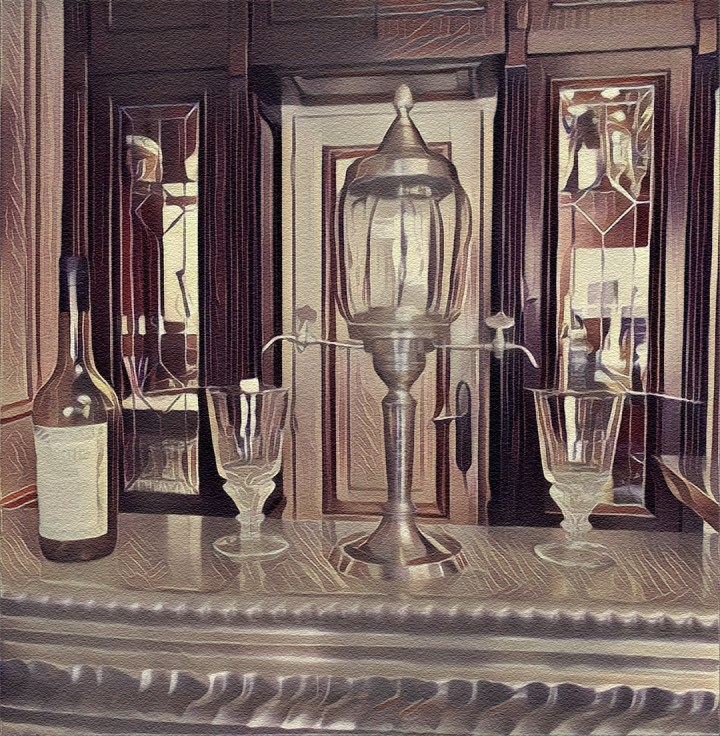
The hotel lobby was small but warm after the chill of the Parisian streets. On the left was a little bar with an absinthe dispenser on the counter. A gaggle of people chatted amiably in the gloom and cigarette smoke, the roiling music of their words suggesting intrigue and drama. To the right was the reception desk and a small neat man sat behind it, a world away from the midday drinkers.

Sir John and Marie walked to the desk and the man looked up expectantly.

“Monsieur?” he said.

“It’s Sir and Mrs Jennings,” said Sir John, somewhat hesitantly. The man’s head twitched as if to change language and he smiled.

“Ah yes, you are to stay with us for a month or so? In the suite?”

Sir John noticed that the group at the bar seemed to murmur in response and remembered it had been like this before. Nothing had gone unobserved.

“Exactly so,” he said.

“You stayed here before?” said the man, his head tilting to one side like a bird. “I seem to recall you.”

“Years ago, yes,” said Sir John, “on our wedding night.”

“Ah yes,” said the man, “I remember now. One moment.”

He leant over and pulled open a draw and rifled through some papers. A sheet was extracted and placed on the green leather desk top. 

“Sign here, please,” said the man and produced a key as he did so.

From behind Sir John a man’s voice rose up from the convivial hubbub.

“You English! Always the same, never bothering to learn the language.”

The group at the bar fell quiet. A look of anxiety fell across the desk manager’s face as he held out the key. Sir John turned round to see a tall, well built man in his forties walk toward them. He had a suit on over a garish purple shirt and a small cigarette hung from his lower lip, which was shaded with stubble.

“How do you expect to get around my city,” said the man, so close now to Sir John.

“Well, monsieur,” said Sir John, “I expect you to help me.”

The quiet reached a nadir as the two man stared at each other, then suddenly both burst out laughing. The group in the bar jumped back in surprise.

“Emile, my friend!” said Sir John. “I’m glad you could meet us.”

“Ah Sir John,” said the tall man, slurring out the honorific, “I am sorry I missed you at the station. I was a little unprepared this morning.”

The desk manager looked confused yet relieved as Marie took the key from him.

“Marie! Ca va?” said Emile.

Tres bon!” smiled Marie, “et toi?”

Emile offered a long shrug and noise by way of explanation.

“Better now,” he said. “We should eat, I have yet to have breakfast.”

“But, it’s practically lunchtime” said Sir John.

“Indeed, so I am famished,” said Emile. He leant forward to the desk manager and said something in French pointing to the Jennings’ bags.

“This gentleman will take care of your bags, come, let us eat, this is Paris after all. We have the best food in the world!”

He pushed out the doors into the midday sun and Sir John and Marie looked at each other, shrugged and followed.

La racine des malapropismes de Miss Henderson – encore

menu“Unfair of what?”

Dear Reader

Well we have all hopefully enjoyed the prologue of the Paris Awakening and your appetites are suitably whetted for the forthcoming serialised novel. For this we shall return to our “two episodes a week” regimen, starting this Saturday hence. This will be followed by another episode next Tuesday and so on and so forth.

We may of course add a little light entertainment, book review, waspish comment or other ephemera on a more or less random basis during the coming weeks. Our aim is to have the novel serialised, completed and enjoyed by your good selves by the end of this year 2018. We would also like wish you a very pleasant New Year and hope this to be the very best of years for you.

Yours

Mr Michael and Miss Pichette


The Paris Awakening: Prologue Part 5

Their eyes locked over the gorgonzola piccante.

“Yes, it was an exciting time,” smiled Sir John. “As you say, the Societe were largely buffoons, and I was all but giving up on them when we met. Then we started all those experiments, trying to build devices that could detect paranormal activity.”

“And all that time, I wanted to tell you about me,” said Marie. “About the powers I had. But, it seemed a strange thing to say at first, and then it got harder and harder to speak. I hoped at first that you would be able to help me find out more about myself, but then I found myself wishing for something different.”

Sir John held out his hand next to the Camembert de Normandie, and Marie reached and held it.

“Me too,” he said. “I was so pleased when we became partners, not just in paranormal investigation, but in romance.”

“And by then, it was impossible to tell you,” said Marie.

There was a pause.

“I have one question, Marie,” said Sir John. “The early investigations, before I knew, how much was the devices and how much was … you.”

“I … helped a little,” said Marie, “at the haunting. But you found the body after all, and even the villain of the piece.”

“And in Manchester?” said Sir John. “It was me that stopped Clackprattle, wasn’t it.”

“Well, yes,” said Marie, “but there is more you must know. This is important. Clackprattle isn’t the mastermind, Pook is.”

“That little twerp?” said Sir John.

“Yes, that little twerp is a magical creature, a pookah,” said Marie. “A kind of trickster that plays with people’s lives. He manipulated Clackprattle in Manchester and I imagine again in London. He is wrapped up with these Draco Viridis cult people, and I’m worried about what he will do. You remember at the end, when Clackprattle seized the Summum Malorum? Something happened to him. Something that can only be bad.”

Sir John nodded gravely.

“Yes, I thought there was something strange happening there,” he said. “I noticed Pook shouting, but I didn’t make the connection. Not for the first time, obviously…”

Marie’s head dropped.

“I’m sorry, I didn’t mean…” said Sir John. “I meant that, that I should have seen these things. I’m an investigator, and, and your husband, and you were in danger because I didn’t see what you were. Who you are.”

Mon cher, I hid this from you,” said Marie. “The fault is with me.”

“No, it’s not,” said Sir John. “Not at all.”

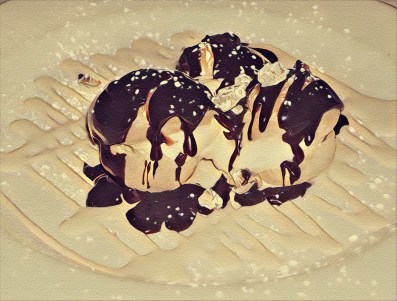
Both the couple looked at their plates. There was another pause which was interrupted by Miss Henderson struggling to bring in a large plate filled with chocolate covered balls.

Prophet-a-Holes,” she said. She looked at the couple who both smiled distantly at her, sadness in their eyes.

“Tomorrow I shall cook us a nice turkey roast,” she said, by way of compensation and left with the half-eaten cheese board.

profiteroles
“Prophet-a-Holes”

“You know what we need to do,” said Sir John. “What you wanted me to do from the start.”

“What is that, mon cher,” said Marie.

“In the New Year, straightaway we shall leave for Paris. We shall go back to where this all started and we shall find out where you came from, how you got these powers, and what they are for once and for all!”

Oui, mon cher!” said Marie beaming at him. In triumph Sir John speared a chocolate ball with a fork, and cream spurted out onto his face.

The Paris Awakening: Prologue Part 4

Miss Henderson arrived with the next course of food and noted with approval the smile on Marie’s face. She put the used plates onto a trolley she had brought and then laid two plates of meat in front of the Jennings.

“This is a gnu,” she said and promptly left. Sir John looked at the meat with suspicion and took a bite.

“Ah!” he said. “It’s lamb. So … you met a gargoyle?”

“I didn’t know at first,” explained Marie, “I was sitting crying, and this old man’s voice said ‘What is the matter mademoiselle?’ It was a rough voice, but you could hear the kindness underneath. I was distraught, hands over my face and said the first thing that came to mind: ‘I’m a monster.’

“‘Hmm,’ said the voice, ‘there are worse things to be.’

“I looked up in confusion and saw that I was talking to a gargoyle. I could see it moving clearly, in fact all of the gargoyles on the building were moving. No one else seemed to notice. ‘Who are you?’ I said.

albrect_PS_tx
“A Monster?”

“‘My name is Albrecht,’ said the gargoyle.

“‘Isn’t that a strange name for a gargoyle?’ I said.

“‘Do you know many gargoyles?’ he said.

“‘No,’ I admitted, ‘I think you are my first.’

“We talked for some time then. I’m sure the people around me thought I was crazy, talking to myself. But many people were crazy then. Albrecht said that he knew I was a witch, that he could tell straight away. Just like the man, the faun, by the river. I asked him what he knew about witches. He told me that of the few he had met, they were nice, friendly, well dressed, and very powerful. I asked him what he meant, and he said they could do powerful magic. When I asked him for more details he shrugged and said, ‘I’m just a gargoyle, Marie. I don’t get around too much.’

“After what he said, that there were more of my kind, that they were good people, I tried to find out all I could. Oh, I went to all sorts of strange things mon cher, to seances and magic shows, trying to find out more. I always went back to Albrecht to tell him what I had learned. It was such a mess of information, some false, some mad, and it was hard to make sense of. I thought I needed some order to this search, so I joined the Société d’Evénements Mystérieux looking for the truth. I heard they had a program of scientific investigation of mysterious events. I hoped they would help me make sense of the patchwork of information I had. Of course, I got little from them. They were charlatans and fools whose theories were fancies made grand by scientific language. The whole thing was a waste but for one thing of course…”

Sir John looked puzzled.

“I met you,” said Marie.

The couple looked warmly at each other as Miss Henderson entered.

“Chef has prepared an ass he et from Marge,” she said and placed some cheese on the table.

The Paris Awakening: Prologue Part 3

Miss Henderson came into the dining room with two covered plates. Sir John and Marie were both looking thoughtful.

“Was the soup satisfactory?” asked the maid warily as she put down the plates and gathered up the dishes.

“Yes, thank you,” said Sir John and managed a weak smile.

“Chef said this is poison,” said the maid and uncovered the plates to show two fish. She noticed that Marie’s eyes were a little red and pushed Sir John’s plate toward him with a glare then left.

“We don’t have to…” started Sir John.

“No, it’s fine, I want to tell you,” said Marie, “On the way to Paris my aunt told me sternly that I must never speak of the events in the village. I didn’t need telling. When we arrived in Paris  it was … encroyable. Never in my life had I dreamed of such a place. The buildings, even then, and the people, hordes and hordes of them. And best of all, none of them knew me or knew about me. I decided to forget about talking to animals, the strange man, and the frozen children, and I think I convinced myself it was a childhood dream.

“So I grew up in Paris, learning the fashions and tastes of the city. My aunt and uncle were … they were not unkind, but they were not warm like my mother had been. I tried so hard to forget that I forgot about her too. Even today I can barely recall her face. When I was sixteen they told me she had died some years before, that they had waited until I was old enough to tell me. That whole other life died on that day, too.

“I went from a being a village child to a Parisian young lady and thought myself very sophisticated at that. It was a nice time, really. And then the Prussians came and the siege. It was terrible. There was no food and we ate … we ate whatever could be found.”

Marie looked at her half-eaten fish. Suddenly she set upon it, tearing the meat from the bones and devouring it.

“I learnt it is good to eat well and to be alive,” she said.

Paris_1871_Prisma
“Paris, 1871”

“This is when your aunt and uncle…” started Sir John. Marie nodded.

“In the shelling, at the end, they perished,” she said. “Then we had the commune and more fighting. It was chaos, my beloved Paris was in ruins, riven by conflict. It seemed like humanity had gone crazy.

“And in the midst of this, I remembered who I was. When the government came back into Paris, they rounded up the Communards. Some of my friends were with them. We heard stories … that people were being killed. I shouted at the soldiers who took my friends and they chased after me. They thought I was a Communard too, I think. I ran through the streets with these men after me, terrified. Eventually, I ran into a dead end, with the soldiers at the other. Once again, like years before I shouted ARRETER. And these men stopped too.”

“I stood paused, thinking it was a trick, but they didn’t move. I ran past the stationary men and away from the street. I ran and ran, frightened of the soldiers but more frightened of what I had done. Everything I had tried to forget was coming back into my mind. After just running wild I found myself at the Notre Dame. I thought I should go inside and ask for forgiveness. But I was frightened that I wouldn’t be able to, that I was somehow tainted. I sat down and cried. Then I heard a voice, from above, and he spoke to me.”

Sir John looked puzzled.

“Do you mean God?” he said.

“No, mon cher,” said Marie smiling, “a gargoyle.”


The Paris Awakening: Prologue Part 1

“Chef has prepared an amused bush,” said the maid and placed the two small plates in front of Sir John and Marie Jennings. She looked dubiously at the small piece of cheese and sauce on the plate.

“I have taken the liberty of informing chef that in this house it is customary to have bigger portions,” Miss Henderson added, “and that you sometime have seconds even then, Sir John.”

“Thank you Miss Henderson,”  said Sir John. “I’m sure that’s very helpful.”

Amused Bush“Amused Bush”

The maid left, and Sir John looked across the elaborately laid out table to his wife who smiled back at him. Their dining room was lit by candles and the glow of the fire, crackling gently.

“It is so nice to have a taste of ‘ome at Christmas mon cher,” said Marie. “Thank you.”

“My pleasure,” he said, “I’m just glad I managed to keep it a secret.”

Marie’s head dropped. Sir John didn’t see as he was eating the food.

“Hmm, she has a point,” he said. “It’s very tasty but not terribly filling.”

Sir John looked up and saw a tear running down Marie’s face.

“I’m sure we can get some more,” he said.

“No,” she said, “it’s not that … it’s when you mentioned secrets I thought of…”

“Oh, I’m sorry,” said Sir John. “I didn’t mean…”

“No, I know, but we ‘ave to ‘ave a conversation,” she said, “I ‘ave to tell you about my past.”

“My dear, it’s Christmas Eve,” said Sir John. “It’s a special day, perhaps some other time.”

“No,” said Marie, “now is perfect. No-one can bother us, and we have this nice food. Please, let me tell you about my life.”

“All right,” said Sir John. “If you like.”

“I do,” she said. “Can you remind me what you know?”

“Well,” said Sir John, “you grew up in a small village where you lived with your mother. Then you moved in with an aunt and uncle in Paris when you were about nine. You lived there but lost them in the chaos of 71 … taught in schools after that … joined the Société d’Evénements Mystérieux where we met, and the rest, as they say, is history.”

Marie looked thoughtful.

Just then, Miss Henderson arrived with two covered bowls. She was looking rather pleased as she put them on the table.

“I believe that chef has taken my suggestions seriously,” she said as she took lids off the bowls which were quite full of clear soup. “Chef said this a bowl of consumption.”

The maid looked at Marie’s uneaten food and took the plate.

“I didn’t like it much either, Mrs Jennings,” she whispered to Marie and left.

“Well, the facts are all true,” she said, “but that story has some gaps. Let me start at the beginning…”

Interview With A Vaper

vaper copy

The following is reprinted from the Fernando Po Literary Review, published Dec 23, 2017. It is an interview with Roberto de Guillermo, editor of that journal and Paul Michael, author. Mr de Guillermo was lucky enough to catch up with Mr Michael at the Tequila y Mota International Airport and was able to conduct the interview in the departure lounge and capture it on his minidisc recorder.

RdG: Oh I’m sorry, are you alright? Let me get your bag.

PM: No, that’s quite alright, just an accident. I can get that.

RdG: Ay! That’s heavy! What do you have in there, gold bricks?

PM: Haha! No, no … er may I take that?

RdG: Wait. Aren’t you Paul Michael, the famous author of the Jennings and Jennings series?

PM: You’ve heard of me?

RdG: Of course, you are famous on this island! Are you in a hurry? I’d love to do a an interview!

PM: Well, my flight to Panama is…

Voiceover (in background): We regret to inform you that the Aeroflot flight AFL123 to Panama City has been delayed by 6 hours.

(Pause)

PM: Apparently I have time.

RdG: So we are all looking forward to the release of The Paris Awakening, your forthcoming novel. We’ve been hearing news of that a lot this year. It must be due for release soon?

PM: Yes, yes it’s due soon.

RdG: How soon exactly? I think I heard it would be out by now.

PM: Well, you know, publishers and so on, and, and marketing schedules, etc, etc. Bit tricky to say right now.

RdG: Of course, of course, but it’s finished now at least?

PM: Well, there is a little editing to do, maybe a bit more writing.

RdG: A few words, I’m sure.

PM: Well, maybe a few at the end. And maybe some in the middle. And possibly one or two at the start.

RdG: One or two words at the start?

PM: One or two thousand at the start.

RdG: Oh.

PM: You see, it’s probably more accurate to say it’s not really completed. And even more accurate to say it’s not even written. It’s the literary equivalent of vapourware. It’s a vapelit romance.

RdG: So this is why you are fleeing to Panama with a sack full of gold bullion?

PM (dejectedly): Yes.

RdG: Mr Michael! Don’t lose heart so quickly! Why you are the mighty author that has written six most exciting serials. Why not treat this the same!

PM: What, you mean serialise the novel?

RdG: Charles Dickens! Arthur Conan Doyle! Alexandre Dumas! What do they teach you about writing?

PM: That I should change my surname to start with D?

RdG: No sir, that the serialised novel can be a classic of literature! Return to your home sir, serialise your novel! Tell your story to the world.

PM: My God, man you’re right! I shall, I shall! (Voice fades)

RdG: Mr Michael, you forgot your bag!

(Sound of zip opening, then exhalation and a clinking sound.)

RdG: Oh well, finders keepers…


The Howarth Haunting: Epilogue

“You’re calling from what? The Manchester Guardian? No, thank you. I have no interest in talking to a provincial paper,” said Sir John and put down the telephonic device.

“These people are like seagulls,” said Sir John to Marie. “They make a racket and pick away at you.”

“Still, it is nice to have you home,” said Marie. “I missed you.”

“And me, you,” said Sir John. “The constabulary had lots of questions, not a few I couldn’t answer. And none seemingly that Lady… that Miss Scrote could answer.”

Marie coughed. “That is her real name?” she said.

“Yes, it seems it is. It’s generally agreed now that her father was Robert Scrote so she’s no longer Lady Howarth and instead is plain Miss Violet Scrote. The newspapers started to get interested, as well, and they had even more questions than the police.”

The telephone rang again.

“Hello? You’re from where? The Washington Post? But the events didn’t occur anywhere near Sussex!” said Sir John, and put the phone down angrily.

“It’s a shame they don’t pay money for these conversations,” said Sir John. “I don’t think Lady… I mean Miss Scrote is likely, or even able to pay us.”

“Oh, that would be monstrous,” said Marie. “People would just make up stories for money…  What will happen to her anyway?”

“To Miss Scrote? Well, it seems Lord Edward had a cousin, Margaret,  who is delighted to take ownership of Grimley Hall. She has an estate already so probably won’t move there. She has said that Miss Scrote may stay there for a while, perhaps work in the kitchens or something, and have a small room. They’ll pay her a reasonable wage, even though she has no employable skills as such.”

“So she won’t move to Cheapside?” said Marie with a smile. “It must be the cousin who sent this,” she continued, indicating a large object on a table in the room.

They both walked over to the table and looked at a bulky object tied under a large piece of tarpaulin tied by string. There was a note that read, “Awfully grateful, Margaret.”

“I didn’t look,” said Marie, “in case it was one of your experiments.”

Sir John untied the tarpaulin and they both peered inside.

“How interesting,” said Sir John and replaced the tarpaulin. Marie did not stop him. “Must be the Howarth naval connection, I suppose.”

Octopus 2“How Interesting!”

“But tell me, how was your trip to the village?” said Sir John. “Did you find Alice Copsey?”

“I did,” said Marie, “and I read her her letters. She was so old and frail. I think this is why the ghost was so active. He didn’t want her to die not knowing the truth. She listened quietly to the letters and at the end she smiled like an angel. And a single tear ran down her face.”

“You may well be right. There hasn’t been a single haunting since you uncovered the skeleton,” said Sir John, when the telephone rang again.

“Now look here, I don’t care who you are or where you are from, but I have no wish talk to you so please GO AWAY!” He paused and turned white. Then his head bobbed down quickly. “Your Majesty!” he said weakly.

The Howarth Haunting: Chapters 13 & 14

Lady Howarth, SIr John and the Bishop were in the haunted room. There were some dull thumping sounds as the Bishop began to speak, waving his crozier. Small objects occasionally flew across the room. Lady Howarth stood imperiously in the middle of the room, defying the spirits, whilst Sir John was wearing the Ectoscopic glasses and looking around wildly. His hair was nearly on end, although it was hard to tell if that was ghostly forces or just terror.

The Bishop was intoning something slowly, when there was a commotion at the door and Marie burst in.

“What is the meaning of this?” said Lady Howarth.

“You must stop this at once!” said Marie. “There is no need for this, I know what has happened.”

Just then the butler came into the room. “Now then, madam, you can’t go in there,” he said and looked puzzled.

“I thought I told you to stop anyone coming in?” Said Lady Howarth to the butler.

“I meant to, your Ladyship,” said the butler, “I don’t know what happened.”

Marie addressed the Bishop, “Monseigneur, you must stop.”

“I don’t know who you are, but I am in the middle of a sacred rite. It is highly dangerous to stop now whilst the spirits are arisen.”

“But it is wrong to continue, I can show you.” Marie turned to her husband. “Mon cher, make ‘im stop, things are not what they seem. I ‘ave it all figured out.”

“What is it, Marie?” said Sir John, “What have you figured out?”

“Sir John, you will remove yourself and your wife from this room,” said Lady Howarth sternly.

Mon cher, please listen to me,” said Marie.

“Sir John, did you hear me?” bellowed Lady Howarth.

Sir John looked at Lady Howarth, then at Marie, and then back between the two, his face looking anxious. The Bishop had paused his litany.

“Sir John!” said Lady Howarth at fever pitch.

“Lady Howarth, I am talking to my wife!” said Sir John loudly, then gentler to Marie, “What is it?”

“It’s what you said at the start,” said Marie, “how we should not be biased by stories and just use fact. What you saw in the portrait in the hall, what you saw the first time you used the glasses, what you saw in the corridor… something is wrong and I can prove it.”

“How?” said Sir John.

“We need to go back to the corridor,” said Marie.

“Out of the question!” said Lady Howarth. “Smyth, remove these two!”

Arrêter,” whispered Marie then ran for the corridor to the west of the room.

“Smyth!” bellowed Lady Howarth, but the man seemed rooted to the spot.

Chapter 14“Pardon, Monseigneur”

Marie ran down the corridor and stopped in front of the portrait of the two boys. Lady Howarth, the Bishop, and Sir John arrived at the end of the corridor, with a bemused looking Smyth behind them. All the paintings and the ornaments were moving and rattling now, creating a racket. The ghostly voice that came out of the Thanatograph could be heard behind the walls.

“What in blazes is that voice?” said the bishop. “What’s it saying? Usurper?”

“I will show you!” said Marie and pulled the boys’ portrait off the wall and threw it to one side. She started banging on the wall with her fists. There was a sound like a drum as she did.

“She’s gone mad!” said Lady Howarth. “Smyth, stop her!”

Smyth muttered something, although it was hard to tell what over the din. It may have just been a cough.

“She is possessed by a demon!” said the Bishop and made towards Marie. He put his hand on her forehead and muttered something in Latin. Marie turned around to face him, looking wild and confused. Then as he continued, her features softened and she smiled.

Pardon, Monseigneur,” she said, and snatched his crozier. She stood away from the Bishop and the wall and held the crozier behind her head. She swung it round with a grunt and hit the wall. A crack started to appear.

“Stop it! Stop it now! Have you forgotten who I am!” shouted Lady Howarth. Marie brought the crozier down a second time and the crack widened.

“I have not forgotten who you are,” said Marie, “but I’m not so sure you know.” With a final swing the crozier smashed into the wall. Plaster fell everywhere to reveal an alcove. And in the alcove, were the bones of a young man. The rattling and chaos and voices stopped instantly.

“I present,” said Marie, breathless, “Lord Edward Howarth.”

“What rot!” said Lady Howarth.”My father is buried in the Howarth mausoleum.”

“Your father may be,” said Marie, “but your father wasn’t Lord Howarth. He was the boy, Robert: Lord Howarth’s childhood companion, and his murderer.”

“This is nonsense,” said Lady Howarth. “What proof do you have for these allegations? You will leave my house at once!”

“Something strange has happened here,” said the Bishop. “It cannot just be swept under the carpet, Lady Howarth. Madame Jennings, you make a bold claim, what evidence do you have?”

“Here,” said Marie, “are letters from Lord Howarth. They explain most of what happened. The rest is…” Marie went silent as she realised she could not explain what she had seen. Sir John went to his wife, seeing her confusion.

“The rest is conjecture at best and hogwash in reality. In any event, there is an easy way to disprove it. Lord Edward had a fall from a horse as young boy. His leg was fractured and never quite recovered. That was kept secret of course to maintain his manly reputation. I don’t know what this macabre find is, or who it was, but unless it has a…”

“…Severe fracture on the upper left femur?” interrupted Sir John, who had been staring intently at the bones, “not made at the time of death, years earlier I would say. Looks like he lost a tooth as well.”

Marie glanced down at the portrait she had thrown from the wall. The picture of Lord Edward looked like it was smiling in a lopsided way, self conscious of his smile.

“I’m afraid, “Lady” Howarth, that it seems there is something to this allegation. As I said, this cannot simply be swept away. The constabulary should be called. There are… implications,” said the Bishop.

“But it can’t be,” said Lady Howarth, turning white. “I would be penniless, a commoner. I’d be forced to live somewhere like Cheapside!”

“Oh,” said Marie. “I’ve been there once.” She put her handkerchief over her nose.
 

The Howarth Haunting: Chapters 11 & 12

Marie sat in the chair in the bedroom and tried to calm her mind with some crochet. Sir John was with Lady Howarth and the Bishop and they were getting ready to start the third attempt to rid Grimley Hall of its unwanted guest. Marie was thinking of the crying boy, trying to solve the puzzle before it was too late. There was a knock at the door and she went over.

“Tea, Madam,” said a quavering voice outside the door.

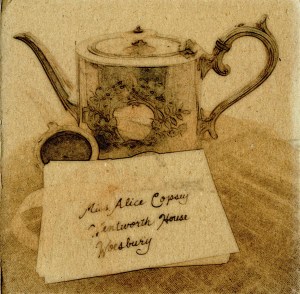
“But I didn’t…” started Marie then opened the door. Outside was the maid from the day before. She held a silver tray with a pot of tea and a cup. It was shaking so much the tea things were rattling. Also on the tray was a set of letters, tied with ribbon.

“I’m sorry Madam,” said the maid, “but I couldn’t help overhearing you yesterday. About AC and EH and… and some letters. Alice Copsey. She’s my aunt, see. Well my great aunt. There were rumours of her and… and the old master…”

“Rumours?” said Marie.

“Well, more sort of facts. They were sweet on each other ‘parently.  She told me about these letters what he wrote, showed me in secret. But she couldn’t read nor write, and she was embarrassed to say, Madam.”

“You’ve read them?” asked Marie.

The girl hung her head. “I can’t read nor write neither. She said, my aunt, I mean, she said when he left, he never said a word of goodbye to her and when he come back, he wouldn’t go anywhere near her. He were like a different man. I thought maybe you could find out what happened. And maybe it’s something to do with all this business, like what you and Sir Jenkins was saying.  She said it broke her heart Madam, when he left. She’s never looked at another man all her life, not even now in her dotage.”

And with that the girl, turned and practically ran away.

“The letters spell it out,” said Marie. She sat back down and looked at them all. The first few were love letters from an Edward Howarth to Alice Copsey. He regaled her with fine words and regretted the circumstances that kept them apart. Marie snorted. She looked at latter letters and he was worrying about his forthcoming enlistment to the navy, how he would miss her, how he feared she’d find someone else. Marie went to the last letter and started to read.

letters 2“Tea, Madam”

“I have a made a plan, a wild plan, maybe, but one I will carry out. I have spoken with Robert and everything is arranged. On the day we leave for Portsmouth, I’ll stop the carriage by the woods, and will go deep inside. Meet me where we went last summer and sheltered from the rain. Robert will disguise himself as me and will join the Navy on my behalf. His friend Cuthbert will go disguised as him.  It will be a good life for Robert, being a naval officer, better than he could have hoped for. As for us, I shall bring a little money and we can elope and start a new life. We will be poor Alice, but we will be together. I gladly, madly throw this manor, title, and fortune away to be with you. I choose you Alice. I choose you.”

“It’s beautiful,” said Marie, “but it’s not what happened. What happened to you?”  She said it idly to herself then looked up and, with no surprise, she saw the apparition looking at her. The ghost boy pointed at the Thanatograph, which began to spin without assistance…

“Where is she? I don’t understand,” said a voice. “You gave her the letter, Robert?”

“That I did, Edward. Same as all the others,” said another voice.

“Then why isn’t she here,” said Edward. “Your friend Cuthbert manage to make it.”

“Maybe because it’s cos she can’t read,” said Robert.

“She can’t… then how did she read the others?” asked Edward.

“She didn’t, but she was too embarrassed to say, and you was too arrogant to ask,” said Robert.

“Well, if she hasn’t read it, she doesn’t know I’m here,” said Edward.

“No. No-one knows you’re here,” said Robert. “…‘cept me and Cuthbert.”

“What’s that, what do you have there?” said Edward. “Is that a knife? What are you? My God!”

There was a nasty sound, wet and harsh, and Edward made a gurgling sound.

“But, I gave you everything,” moaned the dying Edward.

“Let’s just say I wants to make sure you ain’t coming back, if you changes your mind.”

The Thanatograph stopped, and Marie leaned back. “Mon Dieu,” she said. The boy with the tear pointed at the Thanatograph again and it spun some more.

“Why are we stopping here?” said Cuthbert, but it was a new voice, a man’s voice.

“I want the staff to go ahead, make sure that all the old faces have left in case they recognise me, and make our bedrooms nice and warm.” said Robert’s voice, sounding rougher, older, and more assured.

“But why here, Bobby, of all places. It gives me the creeps, you know, when I think about it.”

“Oh grow up, Cuthbert. And it’s Lord Edward to you. Here, get digging, we’re going to take him, or what’s left of him back to the Mansion so no-one ever finds out.”

“Why me, though?” wailed Cuthbert.

“Well for one, I’m Lord of the Manor now, and for another, because you done him in the first place.”

“Don’t remind me,” moaned Cuthbert. “I sees him in my mind every day.”

“Oh cheer up – look here’s ten pounds, you can take that to the tavern afterwards and see if you can’t forget your worries.”

The Thanatograph ground to a halt and Marie ran out of the room, heading to the exorcism.